

The year 2025 will be remembered as a milestone with several path-breaking policy decisions being made to boost redevelopment in Mumbai. MENKA SHIVDASANI looks back.
The last couple of years have seen breath-taking changes in Mumbai, with policy reforms and a massive boost in connectivity. The Atal Setu Trans-Harbour Link and the Mumbai Coastal Road were among the marvels of 2024, and their effects began to be seen as the months progressed.
This year, 2025, however, marks an even more remarkable shift as the Maharashtra government continued its blistering pace of reform. In the midst of big-ticket glamorous projects, the government also turned its attention to some basics, such as sewage; in November 2025, Maharashtra Chief Minister Devendra Fadnavis spoke of new rules for setting up sewage treatment plants across the city.
Here’s a quick look at some of the major, and ongoing, transformations in Mumbai.
1) UNDCPR Amendment
Amendments in Maharashtra standardised development rules, boosting redevelopment with a higher Floor Space Index (FSI), especially for older buildings, and introducing clearer rules for parking, open spaces, among other things. Societies undergoing redevelopment, particularly unsafe or older private buildings, could access FSI, sometimes up to 4.0 (or more with loading), depending on the location and scheme. The amendments included zonal enhancements with increased FSI in specific zones, ancillary areas, and transit-oriented development, among other things, making redevelopment more attractive and feasible.
2) Interest Waiver on Self-Redevelopment
Self-redevelopment got a boost when Maharashtra Chief Minister Devendra Fadnavis announced an 8.5% interest waiver for such projects. This would be applicable to all self-redevelopment projects whose proposals were received up to March 2026, he said. “The premium is to be paid first while the construction begins only two to three years later,” he remarked, while speaking at the inauguration of a self-redevelopment project in Kandivali. “To ease the burden, the premium will be waived for three years only for self-redevelopment projects.” In 2025, the government also announced plans for a Self-Redevelopment Authority to be set up.
3) DCPR Funnel-Zone Amendments
In March 2025, residents in funnel zones—airspace corridors near airport flight paths—received some relief when the Development Control and Promotion Regulations (DCPR) 2034 were amended to ease restrictions for redeveloping old buildings. Developers were allowed to utilise more Floor Space Index (FSI) and Transferable Development Rights (TDR), with lower premiums, conditional relaxations and specific rules to make projects in areas like Santacruz and Vile Parle viable. Today, Vile Parle is a hot zone for redevelopment.
4) Redevelopment of 114 MHADA Layouts
The Maharashtra Cabinet approved a policy allowing for the cluster redevelopment of 114 MHADA layouts across Mumbai on April 8, 2025. The formal public announcement by the Maharashtra Housing and Area Development Authority (MHADA) followed on April 29, 2025. MHADA was designated as the primary planning authority for these 114 layouts, and an FSI of 4 was approved for these projects.
5) Housing Policy 2025 Introduced
Maharashtra's Housing Policy 2025, also known as Majhe Ghar, Majha Adhikar, was formally introduced with the state cabinet's approval in May 2025, followed by a significant Government Resolution (GR) issued on July 23, 2025, initiating its implementation, targeting 50 lakh houses in a decade. Aimed at a slum-free Maharashtra, it plans to achieve 3.5 million affordable homes by 2030 and five million within 10 years; creating a separate, RERA-like law for redevelopment projects and offering inclusive housing with provisions for EWS, LIG, MIG, senior citizens, students, and workers.

6) Digital Approval System for Slum Projects
The Slum Rehabilitation Authority (SRA) in Mumbai officially rolled out its digital approval system, known as AutoDCR Online Building Permission System, in June 2025. The broader initiative for digitising the SRA's processes, which had been ongoing since 2015, aimed to enhance transparency, minimise manual interventions, and accelerate project approvals. The system allows developers to submit their proposals online, which significantly cuts down on traditional paper-heavy and time-consuming processes. It is also aimed at enhancing transparency and tracking, minimising delays in the approval process and boosting RERA compliance.
7) Slum Cluster Redevelopment Policy and Consent Changes
November saw other major changes as well. These included the Slum Cluster Redevelopment Policy. Under the new order, the Slum Rehabilitation Authority (SRA) will lead “cluster redevelopment” on contiguous land parcels of at least 50 acres, where 51% or more of the area is occupied by slums or informal structures. The scheme covers land owned by private entities, government bodies, semi-government institutions, and even hazardous buildings, chawls, and cessed properties. For the first time, Centrally owned land may also be included with mandatory permissions. The state plans to build five lakh rehabilitation tenements by 2030, up from about three lakh units completed since 1995. The Bhoomi Poojan of the Mata Ramabai Ambedkar Nagar and Kamaraj Nagar Slum Rehabilitation Scheme took place in October 2025, marking Mumbai Metropolitan Region Development Authority’s first foray into redevelopment as a developer, while the SRA serves as the planning authority for this project.

8) MHADA / Cluster Redevelopment Consent Waiver
In November 2025, the Maharashtra government's cabinet approved major policy changes, with the Redevelopment of MHADA Colonies 2025 Framework. By allowing MHADA to act as the planning authority, the government aimed at speeding up stalled projects, providing better housing and increasing feasibility for developers. Obtaining individual consent from residents would not be required for redevelopment, and the state noted that the waiver was justified because the policy offered the highest possible rehabilitation FSI. However, developers selected through the tender process would still need to secure a consent resolution from the respective housing societies. The rule applies to MHADA colonies measuring 20 acres or more. Between 1950 and 1960, MHADA built 56 colonies, and there are about 5,000 cooperative housing societies in these.
9) BMC DCPR Revised Guidelines on Demolition and Road Widening
In a circular dated December 15, 2025, updating guidelines under DCPR Regulation 33(12)(B), the BMC issued revised guidelines to end selective razing and piecemeal road widening in Mumbai. The guidelines emphasise that road widening must be complete and contiguous along the entire stretch of a road. According to the revised circular, the new framework aims to standardise and digitise the issuance of NOCs, strengthen inter-departmental coordination and ensure transparency and accountability, among other things.
10) Pagdi System Reforms
In December, the Deputy Chief Minister Eknath Shinde announced plans for a new regulatory framework to overhaul the Pagdi system that would protect the rights of both homeowners and tenants. Fast-track courts would also be established to deal with 28,000 cases pending between tenants and building owners. The Pagdi system is a traditional rental model where tenants gain near-ownership rights, paying low rent while also having rights to sell, sublet, and pass tenancy to heirs, effectively making them co-owners, with landlords. The system has caused much heartburn among landlords and contributed greatly to the poor maintenance of the ageing buildings.

11) The Connectivity Push
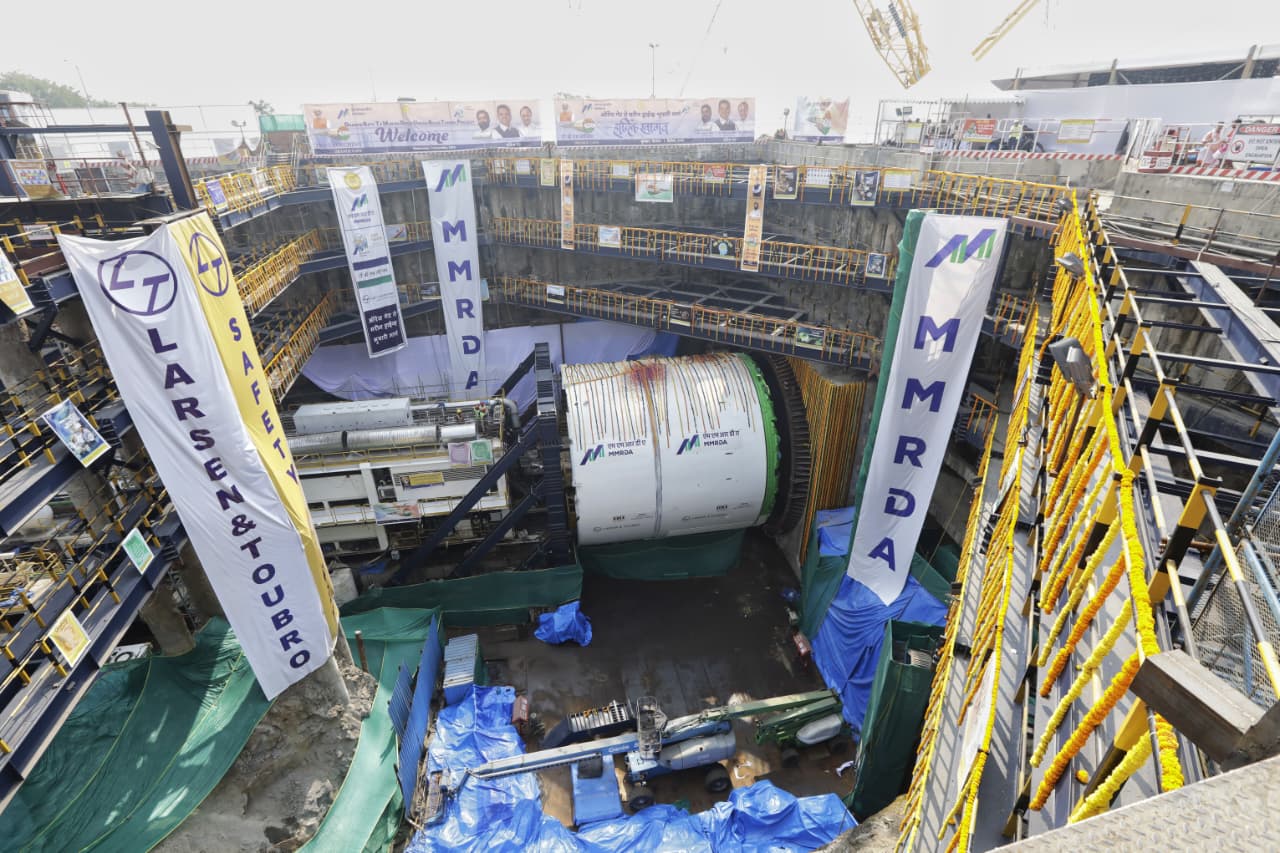
Connectivity has been a major driver for redevelopment in the last year, and will continue to reshape the city. From game-changing metro lines to pod taxis, the government is looking at both mega infrastructure and last-mile gaps that need to be addressed. A significant project that got underway in 2025 is the ambitious Orange Gate to Marine Drive Urban Tunnel Project, India's first urban tunnel project passing through dense residential zones and beneath the Central and Western Railway and 50m below Metro Line 3.

12) Navi Mumbai Airport and Beyond
Mumbaikars also got a Christmas gift in the form of the Navi Mumbai International Airport, beginning operations on December 25 with 48 flights connecting nine domestic destinations. This landmark achievement not only provides a new gateway to the city, but opens possibilities for major development in Navi Mumbai and beyond. Next year should see much more growth in terms of the Third Mumbai, the Karnala-Sai-Chirner New Town—a huge planned urban expansion near the airport, designed as a new economic hub with education, healthcare, sports, and tech zones, and leveraging connectivity from the Mumbai Trans Harbour Link (Atal Setu).
There was all this, and more, in 2025. Mumbai’s momentum was unstoppable, and 2026 should see much more action. 2026, here we come!